Making Space
Jim's Musings from Paris May 2026

What Does Action Serve?
In my last newsletter, I wrote about impulse—the urge to do—where action begins. But that raises another question: what does that action serve?
I find myself returning to ideas I was already circling years ago, though I didn’t name them in quite the same way then. At the time, I was less concerned with creating something new than with placing the actor inside a process that could transform them—not psychologically, not expressively, but physically, concretely, through action.
In our work with New World Performance Laboratory, we speak about devising, though I’ve never been entirely comfortable with the term. The word itself privileges thought. For us, the work always begins elsewhere—in the body, in doing. Action is not the result of an idea; it is the ground from which meaning emerges.
Tendencies
Over time, I noticed a different kind of tension in the work we were doing. This new tension has less to do with where action begins than with what it serves. At times, the work leaned towards display: the actor illustrates, demonstrates, constructs a persona. At other moments, something else would begin to appear—a kind of transparency, where the actor does not disappear, but becomes less insistent, less central. The work begins to pass through them rather than being used as an armor, a mask.
I once named this, somewhat playfully but also seriously, as the difference between ego-theatre and eco-theatre.
Eco-theatre is not theatre about nature. It is theatre as relation. The actor is not the center, but part of a field—of bodies, voices, rhythms, space. Something circulates.
There is often talk of a split—sometimes described as male and female—that runs through both performance and culture. I can feel the traces of this binary way of thinking here as well, though now I’m more interested in how one works through it in practice, gets beyond it.
The Singing Practice
For many years, one of our most important tools in this search was a body of Shaker songs. In truth, they were not just a tool. They were the work.
These songs are simple, direct, and demanding. They do not invite interpretation; they require participation. You cannot “perform” them in the usual sense. You enter them—or you don’t—and if you do, something shifts. The work is no longer about expressing yourself, but about aligning with a structure that organizes breath, movement, and attention.
In this sense, the songs function as a kind of technology of embodiment. They render the actor—or perhaps more accurately, they reveal the actor by removing what is unnecessary.
This is not always comfortable. There is a certain pleasure in display—in being seen, in shaping how one is perceived—but the songs offer no such refuge. They ask for precision, repetition, a kind of surrender—not to an authority, but to a living structure.
Recently, watching a production of Hamlet directed by Ivo van Hove, I was struck again by how much contemporary performance asks the actor to show—to express, to shout, to hold our attention through intensity and effects. It can be compelling. But it returns me to an old question: what is being asked of the actor, and to what end?
DISCRETION: A Detour
At another point in my life, I practiced a very different kind of discipline. It had a name: DISCRETION.
I came of age in the years after Stonewall and before AIDS. It was a time when we learned, often without quite realizing it, how to move between worlds. I had long-term relationships with women and shorter affairs with men. I didn’t hide things exactly—but I didn’t declare them either. With my family, there was an unspoken agreement long before the phrase was popularized: don’t ask, don’t tell.
I became adept at dissembling, at calibrating what was visible and what was not. Looking back, I can see that this movement between worlds shaped me deeply—not only as a person, but as an artist.
When I arrived at The University of Akron in 1989, I encountered a culture of silence that was both familiar and unsettling. There were colleagues in theatre, music, dance—people I knew were gay—but everything was muted: conversations that circled without landing, lives partially revealed. I was told, more than once, to be discreet.
One colleague confided that she had been advised, upon hiring, to wear a wedding ring and invent a spouse who lived in another city. Even the students seemed to understand the rules. Nothing overt. Nothing declared. Everything…contained.
And yet, paradoxically, I never felt artistically censored. On stage, my productions explored cross-dressing, same-sex intimacy, nudity—but even there, traces of that larger atmosphere lingered. It was all there—but not contained. In the theatre, there was no place to hide.
I remember sitting in a faculty senate meeting during a discussion of domestic partner benefits and being referred to—by a fellow faculty member—as a “degenerate” and an “animal.” The words landed, and stayed.
Those years were often marked by a quiet loneliness. There were efforts to build community, some more successful than others. I was part of a small group that pushed, persistently and discreetly, for change. Eventually, those changes came—slowly, unevenly.
I never had a moment when I “came out.” If anything, I came in—into a life that could no longer be split or managed in the same way, into a relationship that made dissembling unnecessary.
Making Space
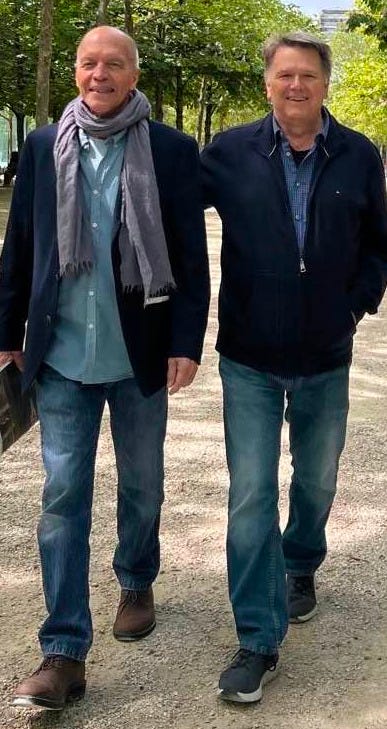
Recently, Jairo and I have been talking about the different ways we make space.
On the one hand, there is discretion—the learned ability to withhold, to edit oneself in order to survive. On the other, there is the kind of decentering we practice in our work—the attempt to step out of the way so that something more essential can take its place.
From the outside, they can look similar. In both cases, the self is less visible, less asserted.
But they are not the same.
One is imposed. The other is chosen.
One diminishes. The other opens.
One isolates. The other connects.
Toward an Ecological Practice
The work with the Shaker songs clarified this, though I wouldn’t have said it that way at the time. In those songs, nothing needs to be hidden—but neither is there anything to display. The actor is present, fully, but not performing identity. Something passes through the group, through the structure, through the action itself.
This is what I have come to understand as a kind of ecological practice—not a rejection of the ego, but a repositioning of it; not hierarchy, but relation; not invention for its own sake, but a return to craft, to attention, to a way of being in which the boundaries between self and other begin to soften.
Where This Leaves Me
In this sense, I find myself both aligned with and at a slight distance from some current conversations in the theatre.
There is, quite rightly, a strong impulse now to challenge hierarchy, to question inherited authority, to dismantle systems that have excluded or harmed. This work is necessary.
But I sometimes wonder if, in rejecting those structures, we may also be feeding another tendency—the pressure to be visible, to assert oneself, to define oneself ever more clearly, to replace one center with another.
The question, perhaps, is not whether we challenge hierarchy, but how.
Can we still ask something difficult of each other without it being taken as control or domination?
Do we move toward a theatre of greater and greater assertion? Or can we imagine a field in which the center is constantly shifting—or no longer necessary at all?
This is where the work still feels unfinished to me—still unfolding. And still necessary.
No more discretion—at least not the kind that asks us to disappear.
But also: no more theatre that exists only to display the ego.
Somewhere between those two refusals, there may be a space where something else can happen.
Fascinating! Very insightful and beautiful one liners that give meaning to your life but also to mine. One of your thoughts that I found very impactful is your concept about transparency, where the actor does not disappear, but becomes less insistent, less central. As I was weaning myself from a life of work, I adopted the quote that a "symbol of success is to become irrelevant". For me it meant to have established a line of succession that allow others to flourish as you, in fact, become less central. However, the irrelevant quote in its simplest way can be seen as a derogative expression, in terms of values and the meaning of one’s life. That’s why I will now adopt your “transparency “ concept that is a much better way of expressing what I mean. Lovely writing. 🙏
Jim, should I come to Paris to meet you for lunch? My schedule is pretty wide open except for May 7 and I’ll be here until May 17.
If you use WhatsApp, why don’t you contact me there at +1-505-542-9050.
Tell me where to meet you and what Metro to go to.